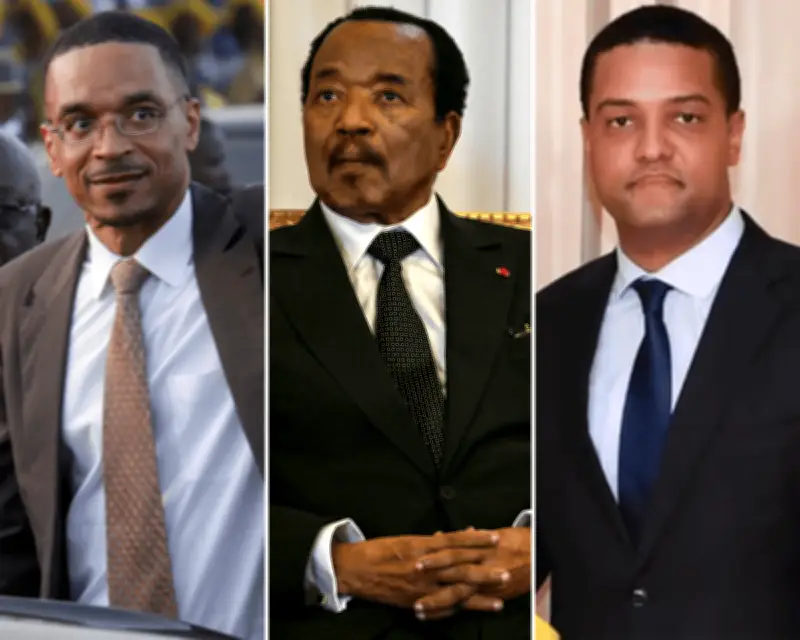
Since taking power in Cameroon 44 years ago, Paul Biya has governed without a vice-president. In 1972, a decade before he first won the presidency, the role was abolished as the central African nation transitioned from a federal to a unitary state. Now, at the age of 93, people close to the world’s oldest head of state appear to have changed their minds. According to critics, they have one thing in mind: the creation of a dynastic system that would transfer power to his son or stepson.
Constitutional Amendment Reintroduces Vice-President
In April, parliament voted to amend the constitution to reinstate the vice-president role, who would be appointed by the president rather than elected. The bill stipulates that in the event of a president’s death or incapacity, the vice-president would take over as head of state until the end of the seven-year term. Under the old system, the Senate leader would take over and an election would be held as soon as possible.
Several names have been mentioned as possible picks, including Ferdinand Ngoh Ngoh, the influential secretary general of the presidency, and Paul Atanga Nji, the minister of territorial administration. Finance minister Louis-Paul Motazé is also understood to be in the running.

Franck Biya and Franck Hertz: The Main Contenders
Reports suggest the role will likely go to either Franck Biya, the first of two children the president had with the late former first lady Jean-Irène Biya, or Franck Hertz, a son of the current first lady, Chantal Biya. Chantal Biya is often referred to as “Madame president” because of the significant influence she wields within government.
Opposition politician Maurice Kamto did not mince words after the constitutional change. “The sitting president is establishing a constitutionally based republican monarchy, with a hereditary or nepotistic dynasty,” he said, describing the amendment as an “institutional power grab”.
Health Concerns and Power Struggles
Discussions about Paul Biya’s health and age are generally considered taboo in Cameroon, but his prolonged absences from the public sphere in recent years have not gone unnoticed, fueling speculation about who really wields power. Ngoh Ngoh, an ally of Chantal Biya, holds the “power of signatory”, allowing him to legally sign official documents and make administrative decisions on the president’s behalf.
Biya’s son and stepson have never held public office and have mostly lived under the radar. Hertz, who has a twin brother, was thrust into the public eye in 2022 after 8bn CFA francs (£10.5m) were reportedly stolen from his Yaoundé residence. The businessman is on the board of Tradex, an energy firm in which Cameroon’s state oil company has a 54% stake. In recent years, he has been joining the presidential entourage on foreign trips. In November 2023, four months after one such trip by Hertz to Moscow, Franck Biya officially collected his membership card of the ruling Cameroon People’s Democratic Movement. One diplomat, speaking on condition of anonymity, said joining the party “after keeping his ambitions low” was a way for Biya to “throw his weight around” and show loyalty to his father.
Regional Context of Dynastic Politics
These machinations are not new in central Africa, where there is a long history of politics being a family affair. In Equatorial Guinea, 83-year-old Teodoro Obiang Nguema Mbasogo, who has been president since engineering a coup against his uncle in 1979, has been priming his son and vice-president, known as Teodorin, as successor. Until August 2023, Gabon had been ruled by the Bongo dynasty since its independence from France. In Chad, the Déby family has held power since December 1990.
Succession Debate and Governance Impasse
In Cameroon, the constitutional amendment reignited a long-running succession debate. For years, Georges Gilbert Baongla, a controversial businessman, has claimed to be Paul Biya’s first son. In April, the 62-year-old claimed on national TV that he was the president’s actual heir and that Franck Biya had been adopted. Authorities have since summoned him for questioning.

As the wrangling continues behind the scenes, governance in Cameroon remains at an impasse. During a speech on New Year’s Eve, Paul Biya said he was prioritising the formation of a new government, but several months later that has yet to happen. Parliamentary elections due last year have been postponed to this year at the earliest.
“In the collective mindset of Cameroonians, deliberate manipulation and machinations underground by the powers that be is known by everyone,” said Levi Mboushou, a political analyst based in the city of Buea.
Cabinet Disputes and Crises
The current cabinet, which contains some ministers who have held the same portfolio for up to two decades or longer, is entangled in several disputes. In February, the investigative newsletter Africa Confidential reported on a feud between officials over operations and contracts at the Port of Douala, the shipping hub of central Africa. Ngoh Ngoh and Biya’s chief bodyguard were on one side, while Motazé, who is considered loyal to Franck Biya, was on the other, along with the prime minister, Joseph Ngute.
“The turf wars of power-hungry aides are threatening the stability of government … the fight over the spoils of power continues,” Africa Confidential wrote. “Some say it spells the beginning of the end of the regime.”
Several crises are festering nationwide, including the Anglophone conflict, now in its 10th year in the west, and a jihadist insurgency in the north. Cameroonians’ appetite for protest has diminished after the deaths of at least 48 people in a crackdown during last year’s disputed presidential election.
Ordinary citizens, Mboushou said, were going about their everyday activity, waiting for an implosion within the elite to disrupt the status quo. “They [the elite] fear that opposition to a father-son transition may not come from the streets but from within power circles … if an entire cast of power brokers are without power, they are likely to cause a rumpus within the political class.”