A tsunami watch has been issued for several Australian neighbours after a magnitude 8.0 earthquake struck off the coast of the Philippines on Monday morning. The undersea quake hit near Mindanao at 7:37am, striking at a depth of 10 km, according to the German Research Centre for Geosciences.
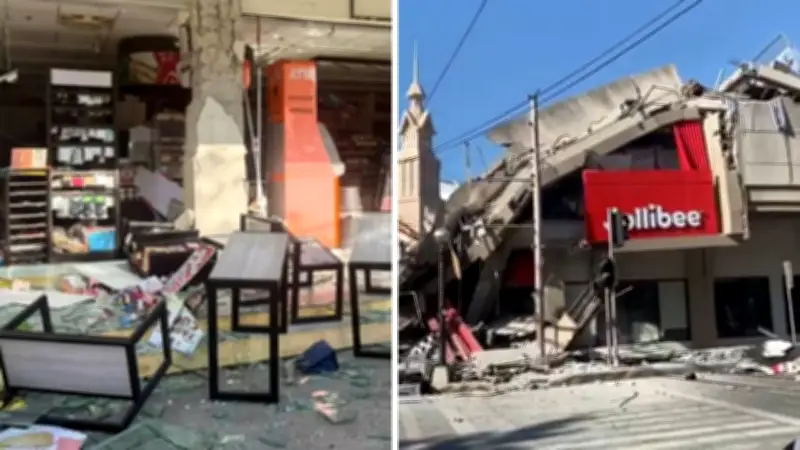
Geophysics agencies in the Philippines and neighbouring Indonesia issued tsunami warnings, but there are no immediate reports of major damage in either country. In footage posted to X, a building under construction and two large cranes can be seen shaking violently, as concerned workers stand below. In a separate clip, fast food restaurant Jollibee is seen crashing to the ground, as dust envelops horrified onlookers who are seen running for their lives. Footage taken after the collapse showed Jollibee’s entire exterior crushed, with its rubble destroying nearby power poles.
Damage and Response
Photos posted by the local information office in General Santos city showed a convenience store completely wrecked in the aftermath. Benjie Ancheta, police chief of Alabel town in Sarangani in the Philippines, said the police building had some cracks immediately after the quake, which occurred during their flag-raising ceremony. Ancheta said there were no immediate reports of casualties, but some people fainted following the strong tremor. “This is the strongest earthquake we’ve experienced,” he told Reuters.

Tsunami Warnings for Neighbouring Countries
The Joint Australian Tsunami Warning Centre issued a tsunami watch for a potential threat to the Northern Territory and Christmas Island, but it was later cancelled. “At this stage no tsunami waves have been observed that may threaten Australia,” it wrote. “If a tsunami has been generated, it may start affecting the following States and Territories after these local times: Northern Territory after 2:30 PM ACST Monday and Christmas Island after 12:00 PM local time Monday. The Joint Australian Tsunami Warning Centre is closely monitoring the situation and will advise immediately if there is cause for concern.”
Filipino authorities have ordered the evacuation of coastal areas. Power and communications are down in the coastal province of Sarangani near the quake’s epicentre, local authorities say. Japan has issued tsunami advisories for various areas along its Pacific coast, from the southern Okinawa islands to Ibaraki prefecture northeast of Tokyo. US authorities have also warned that “widespread hazardous tsunami waves are possible within the next three hours” along the coasts of Indonesia, the Philippines, Palau, Taiwan and Papua New Guinea.
President Marcos Urges Evacuations
Filipino President Marcos has urged residents to “get to higher ground” as tsunami warnings come into effect across coastal provinces in Mindanao. “To our kababayans (countrymen) in the affected provinces, please heed the tsunami warning,” he says. “Move to higher ground now. Do not wait. Your life is more important than anything left behind. The national government is moving, and we will not leave Mindanao behind,” he says. According to the US Tsunami Warning System, tsunami waves could reach 1 to 3 metres above the tide level in parts of the nation.
Historical Context
Authorities have branded Monday’s quake as the “worst” they’ve ever experienced. The island nation is no stranger to earthquakes, with their latest being just last year. In October, 79 people were killed and 1271 were injured following a powerful 6.9 magnitude quake in central Philippines. A total of around 185,900 homes and US$329.62 million worth of infrastructure and other items were damaged, while nearly 10,600 houses collapsed, along with numerous buildings, including churches and hospitals. The Philippines and Indonesia are part of the “Ring of Fire”, an area around the Pacific Ocean where tectonic plates meet and move. The Philippines experiences an average of 20 to 30 earthquakes every single day, which translates to thousands of tremors annually, though only 100 to 150 of these are typically strong enough to be felt.
More to come.