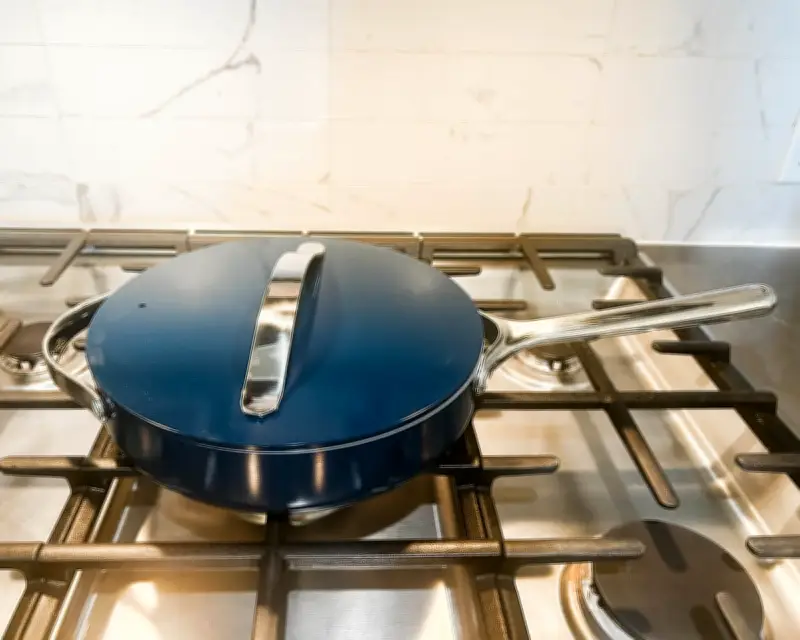
Saute pans are the Swiss army knives of cookware. With tall, straight sides, they can saute, sear meat, shallow fry, braise, steam, and simmer sauces. Most come with a lid to trap moisture and steam. They make everything from glossy deglazed steak to fried onion rings to simple spaghetti with tomato sauce. If you cook a lot of one-pan dinners, they are one of the most hardworking pans in the kitchen.
Caraway, the premium cookware brand, just released a 3qt saute pan. Like the brand's other products, the saute pan has an aluminum core, a ceramic nonstick coating, and stainless steel handles. It boasts a laundry list of nice features: nontoxic and free of Pfas, lead, and other forever chemicals; induction-safe; oven-safe up to 550F; and ridiculously pretty.
I will say right away that Caraway makes some of the best nonstick pans. That has been established again and again by every food publication out there. The Filter even ranked it for best induction-safe cookware. Its pans are expensive, but they are a worthy investment if you want something truly nonstick. I have cooked with Caraway's fry pan and can attest food peeled off with spooky ease. So I went into my test of the new saute pan feeling confident it would do well.

How did it perform?
Heat rate test
To test how fast it heated up, I timed how long it took the pan to bring 1 quart of water to a rolling boil on medium heat. It reached a full boil in about seven minutes, which is squarely normal.
Spill and pour test
I used S&B curry blocks to make an easy curry and brought the sauce to a simmer. The tall sides did an excellent job containing bubbles and splatters, with no spillovers. As for pouring, a small amount of liquid dribbled over the rim when I tilted the pan, but angling it further solved the problem.
Heat distribution test
I seared two skin-on, bone-in chicken thighs with no oil to see how much they would stick and how evenly the pan distributed heat. With only the fat rendered, the chicken thighs glided cleanly around the pan. The sear was somewhat inconsistent due to the ceramic coating, but it still turned out nicely golden overall.
Nonstick test
To test its nonstickiness further, I sauteed onions and tipped the pan over a plate. It all slid out in one neat pile. Possibly the easiest onion saute I have ever done.
Ease of use
At 5.5 pounds, the pan felt just light enough to maneuver, though I needed two hands to fully tilt it to slide food out. Its handle was comfortable to grip, thanks to finger grooves near its base, but the base also got hot quickly, so keep an oven mitt nearby. The helper handle on the pan's other end also heats up fast. However, the handle on the lid took a while to become too hot to touch, which was a pleasant surprise.
So, is this the best saute pan ever?
With all that said, no. This is because no ceramic-coated pan will cook as evenly and responsively as stainless steel. The latter allows you to control temperature better by heating fast and cooling fast, so your chicken thighs can get a lusciously golden, crusty sear all over, like you see in restaurants. If you are seeking the absolute top of the line, I would advise you to get a Heritage Steel or All-Clad pan.
But hang on! Caraway's pan may not be the best overall, but it is one of the best nonstick pans out there. If you are a regular home cook who wants a pan that is lighter, easier to clean, and nonstickier so that your weeknight dinners are not a whole production, then this pan will likely bring joy and happiness to your life. As a lazy cook who does not mind an imperfect sear, I personally have not swapped to stainless-steel pans for this very reason. Serious food people are free to judge me.
How much can you fit in the pan?
Three quarts may be the Goldilocks of pan sizes: big enough to fit four to six chicken thighs or a steak with a side of greens, but not so large that it is a pain to pull out of storage. Dimensions for 3-quart saute pans vary across brands, and this one's diameter is 10.5 inches with a height of 2.5 inches on the sides. Caraway also offers a 4.5-quart pan, which would be great for families and large batches.

What is the difference between a saute pan and a fry pan?
A fry pan has short, sloped sides. Saute pans have high, straight walls that provide more room to cook, though they take up the same amount of stovetop space. They also help prevent spillovers. However, those same walls make it harder to flip, toss, or pour food. If you are making eggs, a fry pan will be better. If you are cooking dishes that require simmering, braising, or sauce-making, you might prefer a saute pan.
How do you clean this saute pan?
It is technically dishwasher-safe, but a saute pan's bulky shape makes it hard to fit in a dishwasher, plus washing by hand can help prolong its nonstickiness. Washing this pan was ridiculously easy because its surface was already smooth; no food bits were stuck on it. I only needed to swipe the sponge a few times.