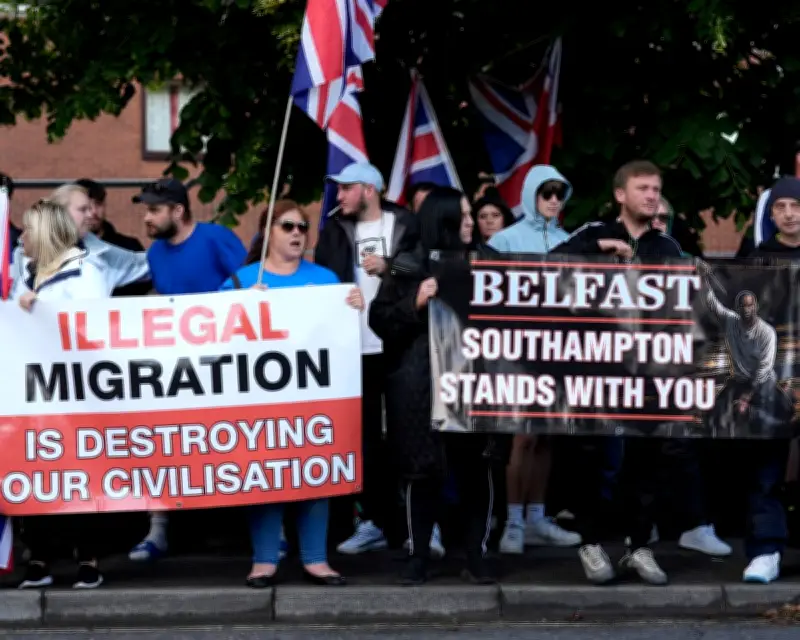
An anti-immigration protest erupted outside a hotel in Southampton after a man from Sudan was arrested over a knife attack in Belfast. The incident has become the latest transnational 'trigger event' for far-right activists, who rapidly spread footage on social media to mobilise supporters.
How the Belfast Knife Attack Became a Far-Right Trigger Event
Filmed at about 10.30pm on Monday night on a Belfast street, bystanders captured the moment when a man, believed to be a Sudanese asylum seeker, wielded a knife over another man he had pinned to the ground. By Tuesday, the clip had gone viral, echoing previous events like the Southport killings and the case of murdered student Henry Nowak.
Far-right activists from Britain and beyond seized on the footage. Tommy Robinson, fresh from a meeting in Moscow with Elon Musk's father, played a pivotal role in spreading the video on X. X eventually placed age restrictions and a warning on the video shared by Robinson, but by Tuesday afternoon it had over 52,000 views, with uncensored versions still easily accessible.

Social Media as a Tool for Mobilisation
Robinson posted details of planned demonstrations across Britain and Northern Ireland, which Musk shared to his 240 million followers. Police and political leaders in Belfast pleaded for calm, cautioning against rumours, but the incident underscored the challenges social media poses to law enforcement and the opportunities for extremists to sow division.
'It fits into the current trend of trigger events where something horrifying happens and is then attached to an existing narrative pushed by the far right, with mass migration being promoted as the reason,' said Joe Mulhall, director of research at Hope Not Hate. 'We saw this in Southport, Southampton, and Epping. The even bigger danger is when you have several such events in quick succession.'
Some rightwing commentators have attempted to link unrelated incidents, such as a stabbing in Manchester, to immigration without evidence. AI-generated images promoting protests have also proliferated. While Telegram was once the favoured platform for organising such actions, activists now openly discuss plans on X.
International Far-Right Involvement
Active Clubs, far-right collectives masquerading as sports clubs, have used the Belfast events to promote a message that young white men need to be 'ready to fight'. International far-right figures also seized the opportunity. Dominik Tarczyński, a Polish MEP banned from the UK earlier this year, tweeted: 'Europe 2026 in two pictures. Mass deportations NOW!' sharing images of the Belfast attack and Henry Nowak handcuffed.
Sid Venkataramakrishnan, an analyst at the Institute for Strategic Dialogue, said: 'It is entirely unsurprising that we’re seeing transnational far-right actors leaping in to exploit the attack, just as we saw with previous tragedies. Boosting these signals across platforms from X to Telegram helps international accounts support compatriots abroad and provides grist for the mill among their own supporters.'
Political Reactions
Right-wing MPs such as Nigel Farage and Rupert Lowe have also weighed in. Sharing a partly blurred image of the Belfast attacker, Farage reiterated that the public 'are entitled to the truth'. Lowe, his rival on the right, tweeted: 'Reform politicians let this monster into our country,' in an apparent reference to former Tory ministers Suella Braverman and Robert Jenrick.