Jeff Tan Bangarra's Sheltering is a powerful showcase of First Nations dance and creativity. Published: June 9, 2026 3.21pm AEST
Frances Rings' artistic directorship of Bangarra Dance Theatre shines through the company's new triple-bill production, Sheltering. Rings demonstrates a commitment to uplifting company members and First Nations creatives, with a coherent curatorial vision that shows care for diverse audiences. This triple-bill is a beautiful sampler of what this important company has to offer to the cultural, political and creative facets of our nation.
A nurturing home for First Nations creatives
Sheltering comprises three individual choreographic works: Keeping Grounded, Brown Boys, and Sheoak. Sheoak is a 2015 work by Rings herself, commissioned by then Artistic Director Stephen Page. Keeping Grounded (2023) is choreographed by Indjalandji-Dhidhanu and Alyawarre woman Glory Tuohy-Daniell, with a cast of eight company dancers.

The most recent work is a short dance film called Brown Boys (2024). It was directed by Cass Mortimer Eipper and Daniel Mateo, a Bangarra company member and Gomeroi and Mari Ma'ufanga, Tongatapu (Tonga) man. Both Brown Boys and Keeping Grounded were first presented in Bangarra's emerging artist showcase, Dance Clan, and supported from there onto the mainstage program. Creators Tuohy-Daniell and Mateo trained at NAISDA, Australia's National Indigenous Dance College, and joined Bangarra through its Russell Page Graduate Program, which provides training and mentorship for new company dancers.
Keeping Grounded
Keeping Grounded opens onto an enormous and heavy rope net designed by Dyarubbin woman, Shana O'Brien. Under it, figures twitch and roll like a catch of fish. Karen Norris' textured lighting supports the impression of a coastal setting, and "sets the scene" across the work as it shifts from an evocation of Country to a more technologically-mediated aesthetic.
In an interview with Glory Tuohy-Daniell, the choreographer describes how the work invites viewers "to consider how small, almost forgotten actions keep us grounded [...] a step barefoot, a moment of stillness, a return". Tuohy-Daniell's movement vocabulary is striking for its literal groundedness, reflecting the central theme highlighted in the work's title. The first sections see the dancers bound to the floor with a variation on the typical angular, rolling, swooping and sharply delineated shapes of Bangarra's Indigenous contemporary style – here purposefully fractured. Set to a score by Brendon Boney, the movement in this section is broken into one movement per beat, a staccato rhythm that suggests a disconnect from the flow of nature. This "pixellated" quality makes familiar forms new in an exciting way.
Brown Boys
Six-minute dance film Brown Boys is a meditation on the experience of young First Nations men. Daniel Mateo, the writer, choreographer and performer, has a cultural background spanning northern New South Wales and Tonga. The program notes describe Brown Boys as a total work of art involving poetry, choreography, cinematography, sound and dramaturgy. Adding to this is the central role of sculpture.
Set and costume designer Elizabeth Gadsby has worked with traditional forms to establish a culturally informed aesthetic. This includes a fale (pronounced "fah-lay"), which is a traditional Tongan shelter made of grass matting. This structure frames Mateo's body inside the film frame. Ochres, minerals and soils are other material elements featured in the design and choreography. The striking final image shows Mateo literally grounded by a soil mound that takes the silhouette of a 19th century crinoline skirt.
Mateo's text and performance are extraordinary. His direct and settled gaze to camera, gentle unfolding movements, and spoken word poem, give visibility, dignity and complexity to the figure of the young Indigenous man. That he has "always been beautiful" could not be more persuasively portrayed.

Sheoak
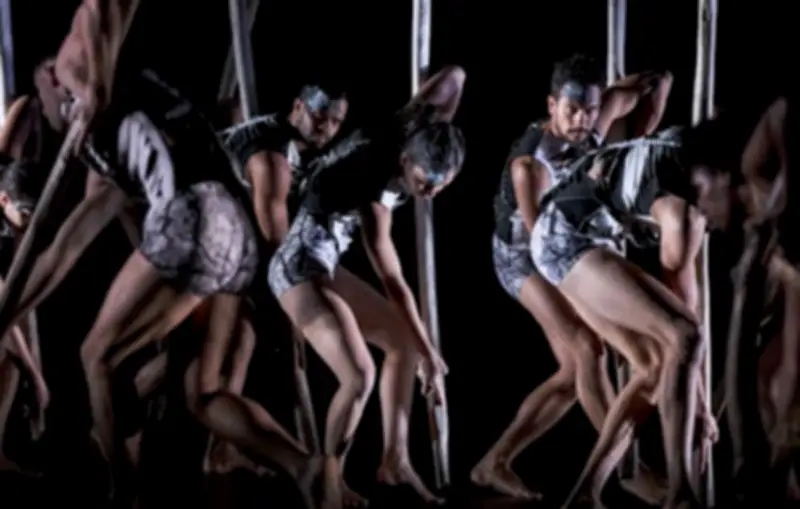
Rings' mastery of group choreography was recently showcased in her commissioned work for the Australian Ballet, Flora. Having delivered another major work for Vivid 2025, this was likely the right time to revive one of her classics. The opening image of Sheoak showcases both Rings' choreographic skill and Jennifer Erwin's amazing legacy as a costume designer. The dancers wear shirts with black on white streaks – skeletal puzzle pieces that join together to form larger human sculptures.
The theme of this work is cultural strength, resilience and adaptability, with the sheoak tree as the central metaphor. Dancer Chatelle Lee Lockhart is captivating in the role of this "Grandmother tree", as it's known to the Dharawal people. The choreography weaves around Jacob Nash's set design, featuring seven two-metre-long branches. The passing of branches signals the struggle to pass on cultural responsibility and knowledge from generation to generation.
The company of technically virtuosic dancers seems right at home in each of the three diverse works of Sheltering. The program particularly underscores Tuohy-Daniell's potential as a new leading light in Australian choreography. Sheltering as a whole is dedicated to the late David "Dubboo" Page, brother of former Artistic Director Stephen Page. David's work as composer, singer and musician was central to establishing the Bangarra aesthetic. His music also features in Rings' Sheoak.
Sheltering is on now at the Sydney Opera House until June 13. The production will show at the Arts Centre Melbourne from June 18 to 27, and at the Queensland Performing Arts Centre from July 9 to 18.