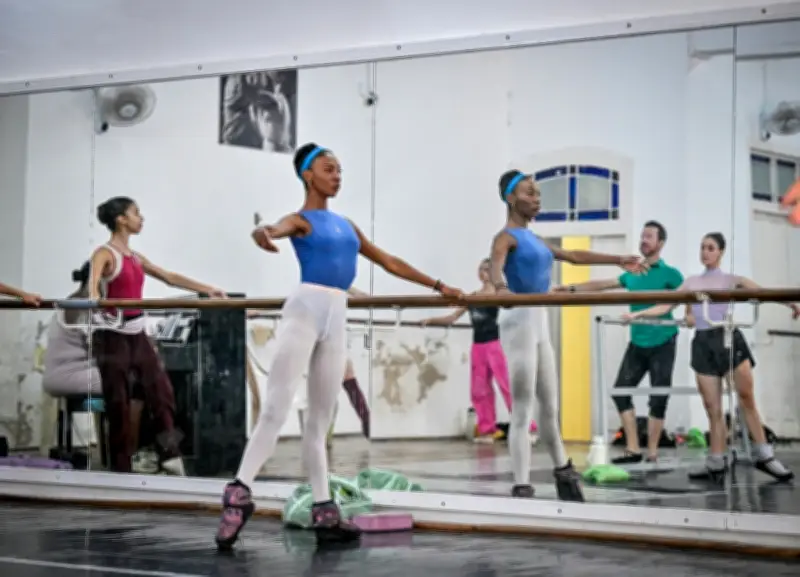
The show must go on for ballerinas in crisis-hit Cuba. Laura Kamila Rojas, a soloist with the National Ballet of Cuba (BNC), dances through transport woes, lengthy power cuts, and economic hardship that now define daily life on the Caribbean island.
Twirling and pirouetting, the usually shy 25-year-old transforms into a commanding performer onstage. Rojas nabbed the coveted position a year ago, but it hasn't been easy. The Afro-Cuban dancer balances a pivotal moment in her career with fuel shortages that have drastically curtailed Cuba's cultural scene and every other walk of life.
"It has been a bit difficult," she told AFP. "The blackouts sometimes keep me from getting any rest, but I always do whatever I can. I get up and tell myself that I can do it, and I keep moving forward."

Ballet in Cuban Life
Ballet has featured prominently in Cuban cultural life since the 1959 Revolution, which democratized access to the arts. Overseen by the late ballet legend Alicia Alonso, the country developed its own school and proudly maintains one of the world's most prestigious companies. Rojas has become a star, receiving enthusiastic accolades from the hard-to-please crowd after her role as Swanilda in the comedic 1870 ballet "Coppelia." "Bravo, Kamila!" the audience cried after a flawless sequence of turning jumps during an April performance at Havana's National Theater.
Born in Jesus Maria, a working-class neighborhood with strong Afro-Cuban influence, Rojas' life was imbued with song and dance from day one. With a mother who danced in a folkloric group directed by her father, her decision to pursue pointe work over family tradition surprised everyone. Now, her passion encounters countless obstacles due to severe fuel shortages in US-blockaded Cuba.
Daily Struggles
Every day, Rojas looks for a way to get to her dance studio, located five kilometers from her home. "If necessary… I'd come on foot," said the young dancer with angel wings tattooed on her back. Company buses are now only available on performance days due to fuel shortages. Previous all-day rehearsals have been scaled back to just four hours to save electricity and give dancers time to get home. "But the demand on us is the same," said Rojas. "We all want to be here, because this is what we love."
A lack of sleep makes the challenging work even trickier. At night, using air conditioning or a fan to offset the intense summer heat has become impossible due to outages. Mosquitos also have to be reckoned with. But "when I dance, I forget everything," said Rojas. "Anything can happen, but my thing is dancing."
Company Spirit
BNC director and prima ballerina Viengsay Valdes, 49, takes pride in this attitude. "They have a lot of talent and a real desire to dance, and that is essential," she said. Despite a slump in Cuba's cultural activity, the Ballet has forged ahead with rehearsals and performances. "The dancer needs the stage," said Valdes. "If they stop, that body has to be trained all over again."
The efforts have not gone unnoticed — the theater's 2,000-seat hall almost reaches capacity during shows, whose schedules have been adjusted depending on electricity availability. Elegantly dressed spectators arrive, either taxied by bikes or motorcycles or on foot, defying the punishing heat and lack of relief. "You sit there watching the ballet, in the middle of Havana, with so many problems, and it's like a bubble that takes us out of reality," said Teresa Betancourt, a 52-year-old teacher, after attending a performance. "It's strange, but beautiful."