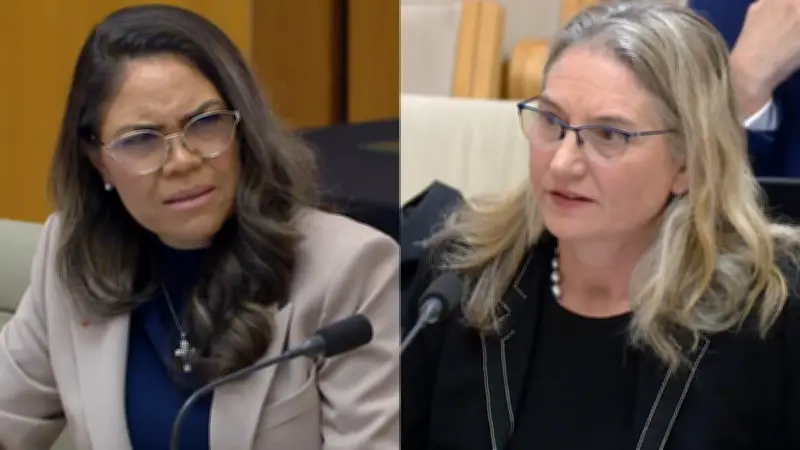
Liberal Senator Jacinta Nampijinpa Price has questioned the Australian Securities and Investments Commission after it attributed the surge in small business insolvencies to the businesses' own 'poor financial control' rather than the Albanese government's economic management.
During a Senate estimates committee hearing on Friday, ASIC presented data revealing that insolvencies have climbed by 200 per cent since 2022. The figures show that the Albanese government has overseen the highest level of corporate insolvencies since the COVID-19 pandemic, with first-time insolvencies rising from 7,362 in the 2019-20 financial year to 14,722 in 2024-25. The number of businesses entering insolvency soared from 3,812 as of April in the 2021-22 financial year to 11,715 at the same point in 2025-26, representing a 207 per cent increase.
ASIC commissioner concedes insolvencies 'concerning'
Shadow small business minister Jacinta Nampijinpa Price pressed ASIC Commissioner Kate O'Rourke on the 'fairly dramatic' increase over the three-year period between the 2022 and 2025 financial years. Ms O'Rourke acknowledged that ASIC data for the first nine months of 2025-26 showed 10,613 first-time insolvencies, a 'high number'. However, she noted this was 2.5 per cent lower than the 10,880 recorded for the same period a year earlier. 'So I think we are in a world where there is a slight decrease on that nine-month amount,' she said. 'Nonetheless, a very high number and a concerning number economically.'

Post-pandemic 'normalisation' excuse has 'diminished'
Ms O'Rourke argued that it was important to consider the number of companies in operation as the 'denominator' underpinning the statistics. She said the ratio of companies entering administration from March 2022 to March 2026 had come 'slightly down' to about 0.4 per cent, 2.5 per cent lower than the previous year. Senator Price pushed back, asking if ASIC accepted that the 'human impact remains significant' regardless of how the statistics were represented. 'Yes,' Ms O'Rourke replied.
Senator Price then asked at what point a sustained period of about 15,000 annual insolvencies ceases to be a post-pandemic 'normalisation' and becomes a 'structural concern'. The ASIC Commissioner conceded that the COVID 'driver' had 'diminished' over time, before pointing to sector or geographic specific variables as sources of 'financial stress'. 'I think that does go to some of the drivers, and you're right that in earlier years, that Covid-related driver was one of them and it has diminished over time,' she said. 'Some of other aspects of either sectorally specific, geographically specific or business specific issues that can generate the financial stress and loss can increase in predominance over something like Covid lag.'
Businesses blamed for their own insolvencies
Senator Price put pressure on ASIC to address the Albanese government's effect on business and asked whether it agreed with the Reserve Bank of Australia's assessment that weak demand, high interest rates and resumption of ATO enforcement were the main contributors to insolvency. Ms O'Rourke took the question on notice. Senator Price then asked about any emerging sectors of concern. Ms O'Rourke said ASIC focused on data applicable to all sectors, noting a 'significant uptake' in small businesses restructuring their debt before continuing to trade.
ASIC Chair and Accountable Authority Sarah Court then addressed Senator Price's earlier question on the main contributors to insolvency. 'The four reasons that have come up in our latest series of insolvency statistics are firstly inadequate cash flow or high cash use,' she said. 'Secondly, what's described as poor strategic management of the business. Thirdly, trading losses. And fourthly, poor financial control including lack of records. So those are the reasons that the small businesses themselves have identified as to why they've entered into insolvency.'

Senator Price sides with small businesses in uphill economic battle
After ASIC placed the main responsibility for small businesses going bust on their own 'poor strategic management', Senator Price said small businesses told her a 'very different story'. 'ASIC pointed to poor strategic management, trading losses and cash flow problems as leading causes of insolvency. But small businesses tell a very different story,' she told SkyNews.com.au. 'They are being squeezed by higher interest rates, higher electricity prices, rising insurance costs, weaker consumer demand and increasing pressure from tax debt recovery.'
Senator Price questioned whether thousands of small business owners had suddenly become 'poor managers at the same time'. 'Or are they operating in an increasingly difficult economic environment?' she asked. 'When insolvencies have increased by almost 200 per cent since FY22, it is hard to argue the problem is simply poor management. Broader economic pressures are clearly playing a significant role. After four years of Labor, small businesses deserve an economy that rewards effort, investment and aspiration, not one that makes survival harder with every passing year.'
Senator Price also highlighted the construction sector, which has the highest number of insolvencies. 'At a time when Australia needs more homes than ever, ASIC confirmed that construction remains the sector with the highest number of insolvencies,' she said. 'Everywhere I go, builders, subcontractors and small operators tell me the same thing: costs are rising, margins are shrinking and confidence is falling. You cannot solve a housing crisis while the very businesses needed to build those homes are under increasing pressure.'
What the data says
More than 45,000 businesses have entered insolvency for the first time during the entire period of the Albanese government. Since Labor came to power, the construction industry saw the most insolvencies over the four-year period, rising from 1,639 in 2021-22 to 4,888 in 2024-25. For four consecutive years, about one quarter of all corporate insolvencies have occurred in the construction sector.
'These figures are yet another sign of the pressure small businesses are under after four years of Labor,' Senator Price told SkyNews.com.au. 'Small businesses have been hit by rising costs, higher interest rates, weaker consumer demand and growing pressure from tax debt recovery. Many operators who survived COVID are now struggling through a prolonged cost-of-living and cost-of-doing-business crisis that shows no sign of easing.'
Experts have also pointed to the Australian Taxation Office's post-pandemic debt recovery efforts as a significant contributor to the rising level of insolvencies. Speaking to SkyNews.com.au, CreditorWatch Chief Economist Ivan Colhoun said the two biggest drivers of insolvencies since COVID were interest rates and energy prices. 'From 2015 to 2020 interest rates and energy prices came down, growth was pretty good,' he said. 'Then you had Covid, and obviously there was huge government support, interest rates went to zero and the ATO was very lenient as it wasn't chasing companies with tax debts. Then when we came out of Covid, these things started going in the other direction, ATO began its reinforcement activities and interest rates went up a lot.'
However, Mr Colhoun noted that while the rates of insolvency were higher, the change was 'not as dramatic' as suggested by ASIC's data.