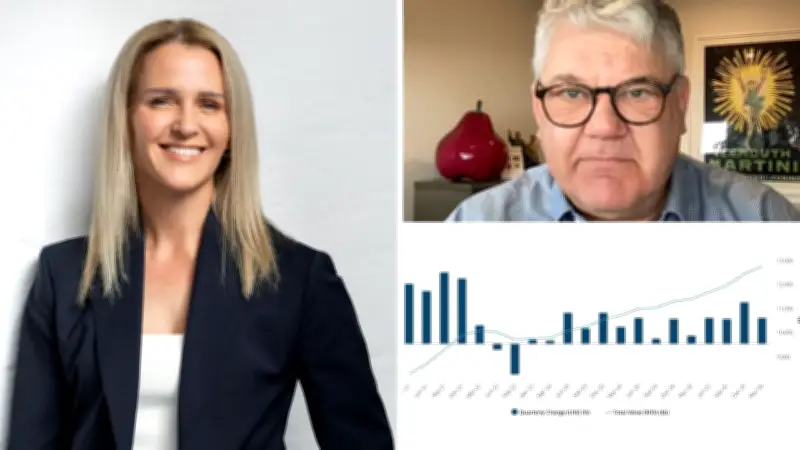
A leading economist has bucked the trend of doom around the property market, saying history showed it would only ever head one way long-term. Stephen Koukoulas argued property prices should still rise by 50 per cent over the next decade, declaring history showed housing “will never fall” meaningfully over the longer term.
Despite current predictions of 10 per cent falls due to interest rate hikes, wider economic pressures and proposed investment tax reforms, Koukoulas said 150 years of data suggested it would not be a sustained trend. “And in fact, house prices in three years, five years, 10 years from now will be materially higher than they are today,” he said last week.
“So yes, there’s a cycle occurring. Unemployment’s going up, supply is going up. Demand is going down. So house prices will be weaker over the course of the next 12 to 18 months. However, let’s take a step back and think about what drives house prices in a fundamental way.”

Data from the Australian Bureau of Statistics (ABS) released on Tuesday revealed residential dwelling prices rose 2.5 per cent or $315.9 billion to $12.8 trillion in the March quarter. Dr Mish Tan, ABS head of finance statistics, said growth had “moderated” after a strong end to 2025 but stock was now 11.9 per cent higher than a year ago.
Victoria was the only state or territory to see a fall in the mean price of residential dwellings this quarter (-0.3 per cent or -$2400). Western Australia (7.2 per cent, or $73,700) and Queensland (4.6 per cent or $49,800) recorded the biggest rises.
Koukoulas, a former senior adviser to prime minister Julia Gillard, explained in a video posted on Thursday that rising labour and material costs would inevitably keep driving property prices up long-term. In a scenario where inflation sat between two to five per cent over the next decade, he said the price of items like windows, bricks and cement could rise up to 40 per cent. If it could be assumed wages for tradies went up four per cent over each year, “the labour costs of assembling a house will go up by around about 60 per cent or there or thereabouts”. “So materials plus labour over a 10-year period house prices should rise by 40 to 50 per cent as a replacement cost,” Koukoulas said.
The senior economist said property developers would not build if the price of a dwelling was lower than the cost of construction, which could see housing shortages and thus price rises. “So it’s a roundabout way of saying that in the long run, house prices will never go down,” Koukoulas said. “They will always go up as they have for the last 150 years there’ll be little cyclical blips and blops and things that happen what which we’re seeing right now as I said linked to the unemployment rate rising among a couple of other things.”
Prices in Australia’s two biggest cities, Sydney and Melbourne, have already been sliding in 2026 as first interest rate hikes and then major tax reforms became investment hurdles. Federal Treasury papers forecast changes to capital gains tax and negative gearing concessions to reduce property price growth by a modest two per cent nationally, while some economists have predicted the market had reached the end of its decades-long supercycle.
Market in ‘transition period’ – but for how long?
The trend has seen federal government ministers grilled over whether or not they want house prices to grow or fall, as they defend the tax changes as key to levelling the playing field for first-home buyers. “What we want to see is sustainable growth,” Housing Minister Clare O’Neil said in a tense exchange on Sunrise last week.
Asked about Koukoulas’ prediction, top property market analyst Louis Christopher said a “few things would need to go his way” for it to be proven true. The managing director of SQM Research agreed the “current housing downturn will not be with us forever” and said Australia was now in “an adjustment period”. He forecast investors would not come back into the market until properties started to become cashflow positive – or positively geared – as rents grow and prices fall. “I think that transition period is going to last two years,” Christopher said. “So I don’t regard this downturn as a short-term thing.”

He said, however, housing being traded at below building costs happened “for an extended period of time” in the US and Japan and it did not necessarily mean the market would recover due to decreased construction. Christopher pointed to the example of Japan, where the property market had collapsed while the Asian superpower grapples with a declining population. He said Australia’s migration and population growth was “one of the key reasons why we’ve got a situation where housing prices have been rising above income growth for many, many years now”. If that was reduced, in line with political sentiments, there would be downward pressure on property prices.
A 10% fall ‘pretty minimal’
Ray White chief economist Nerida Conisbee agreed with the notion that property costs would rise over time, adding “there’s a natural floor as to how far they can go”. “They can fall … but hopefully (people) are aware of the fact that housing price or house price growth is more complicated than just interest rates,” she said. “And at the moment, we have high construction costs, we’re not building enough, and all of those things will keep them more elevated than if we had a really well-supplied market.”
Conisbee predicted prices would stabilise or fall slightly over the next year but it would come after “an incredible run” of exploding growth. “And if we do see a drop of, I think the most bullish drop is 10 per cent … it only takes us back to about July last year. So it’s pretty minimal in terms of overall impact,” she said. “If you go to markets like Perth, which have sort of been increasing at sort of 20 to 25 per cent, it doesn’t even take you back until barely the start of year. So you do need to put that into perspective that we have had this incredible growth.”
Conisbee used the inner-city Melbourne suburb of Collingwood as an example of how high construction costs were exceeding apartment sale prices. She said the fact developers were not able to “stack up” some projects that were affordable only a few years ago meant supply pressures could remain an ongoing issue.
Scott Phillips, The Motley Fool’s chief investment officer, believed interest rates, inflation and tax changes would mean “house prices are depressed for an extended period of time”. “On the other hand, you’ve got household formation and cost of construction, as Stephen said, which are putting upward pressure on price,” he said. “And that is kind of going to be the combination that determines what happens next.” Phillips said increased construction costs and population growth were “not new” pressures on the market, and it was “those newer things” like tax changes and rates that were “changing the trajectory”. “And I think that’s probably why, all else being equal, we’ll see nowhere near as much growth as we have,” he said. “We may well see declines.”