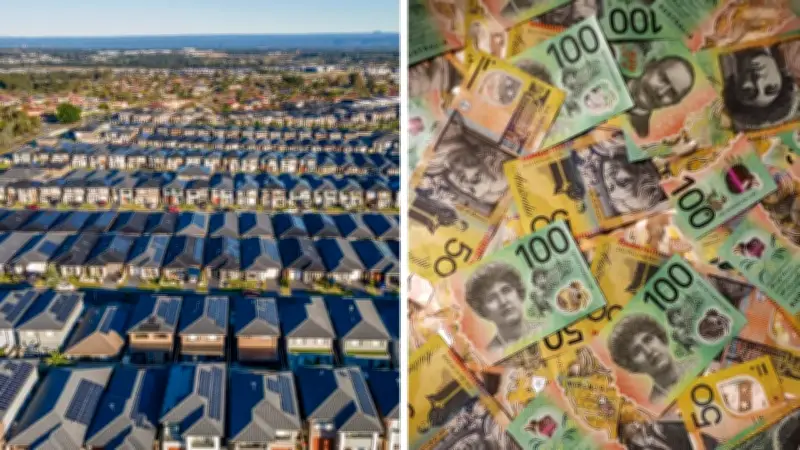
Bank of America economists have issued a stark warning that Australia's house prices will continue to fall, as talk of a market correction intensifies. The nation's property turmoil has captured the attention of Wall Street, with the major bank cautioning millions of Australians that a reckoning is approaching.
Wall Street Takes Notice
Australia's housing market has become so overheated that it is now attracting scrutiny from some of the biggest names on Wall Street. After decades where property seemed to move in only one direction, the message from global financial giants is becoming harder to ignore for Australians deeply invested in real estate.
Australia's housing market has been one of the great wealth-generating machines of the 21st century, rewarding investors with years of capital gains, generous tax settings, and relentless demand. However, for the first time in a long while, the gravy train appears to be slowing.

Bank of America has become the latest global financial heavyweight to warn that Australia's decades-long property boom is facing serious headwinds. The bank forecasts that Sydney and Melbourne house prices could fall by as much as 8 per cent in 2026, driven by higher interest rates and Labor's tax changes that dampen investor demand.
Growing Consensus for a Slowdown
This warning places Bank of America alongside a growing list of major institutions predicting a housing slowdown. Commonwealth Bank recently downgraded its forecasts, now expecting Sydney prices to fall 6 per cent and Melbourne prices to drop 7 per cent. UBS has also warned that national dwelling prices could slide between 3 and 5 per cent over the next year.
For many younger Australians, the prospect of falling house prices would have been almost unthinkable just a few years ago. Over the past two decades, housing has become one of the country's most lucrative wealth-building tools. Prices in Sydney, Melbourne, Brisbane, and Perth have surged far beyond wage growth, creating vast fortunes for existing homeowners while leaving many younger Australians feeling permanently locked out of the market.
Property ownership has increasingly become a dividing line between those accumulating wealth and those struggling to enter the market. There are signs that the tide may finally be turning, as economists, analysts, and property researchers increasingly use a word that was once considered almost taboo in Australian real estate: correction.
Factors Driving the Downturn
Bank of America economists Nick Stenner and Johnny Liu explained in a note to clients: "The slowdown reflects higher mortgage rates weighing on borrowing capacity and demand, alongside Budget policies that dampen investor activity. These headwinds will likely be amplified by weaker sentiment and a softening economic backdrop. However, we expect a relatively short downturn, with housing momentum likely to turn in early 2027 as expectations of RBA easing build."
They added: "We expect housing credit growth will fall to around three per cent year on year in early 2027, led by a sharp drop in investor lending." Recent analysis has pointed to early signs of a housing market correction emerging in Sydney and Melbourne, as higher interest rates, affordability pressures, and tax changes begin to weigh on demand.
Reduced Investor Demand
The latest concern among economists is that the market will lose investors, traditionally one of its most powerful drivers. Bank of America's economists argue that higher mortgage rates are reducing borrowing capacity, while changes to negative gearing and capital gains tax concessions are making investment property less attractive.
"Restrictions on negative gearing for established housing and replacing the CGT discount with indexation alongside a 30% minimum tax rate also weigh on prices through reduced investor demand," they said. "Negative sentiment effects associated with tax policy and a weakening economy should amplify the drag, with homebuyer sentiment dropping sharply in recent weeks."
Consumer confidence has also weakened, with Australians increasingly pessimistic about their finances and the outlook for housing.

Not All Doom and Gloom
Despite the warnings, it is not all doom and gloom for Australia's 2.3 million property investors. Many economists still expect prices to resume rising once interest rates eventually fall. Chronic housing shortages, strong population growth, and rising construction costs continue to provide support for the market over the longer term.
After beginning 2026 with strong growth of around 0.8 per cent in January, monthly gains steadily weakened through February and March before slowing considerably in April. By the time Labor announced its tax changes in May, national dwelling values had effectively flatlined, marking the weakest result in more than a year.
Multi-Speed Property Market
The national figures also mask a growing divide between Australia's major housing markets. Sydney and Melbourne, where prices have risen furthest over recent decades and affordability is most stretched, both recorded declines in May. Sydney values fell 0.9 per cent over the month, while Melbourne dropped 0.8 per cent. Meanwhile, Perth continued to lead the nation with growth of 1.5 per cent, followed by Brisbane at 0.9 per cent and Adelaide at 0.5 per cent. The result has reinforced the view among economists that Australia is now operating as a "multi-speed" property market, with the eastern capitals correcting while smaller capitals and resource-driven markets continue to rise on the back of population growth and housing shortages.