Property vendors are being warned to abandon 'hope' for 'realism' after the auction market fell to fresh lows at the weekend.
Melbourne recorded a preliminary clearance rate of 52.3 per cent, down from 58.1 per cent a week ago and its lowest result in five years, according to Cotality. Sydney's rate rose to 52.9 per cent — up 1 per cent from a week ago — but it was still 5.2 per cent lower than the same time last year.
Melbourne's result was down a staggering 13.6 per cent from a year ago. The preliminary rate for the combined capitals also fell to 51.1 per cent: the 'lowest since April 2020', The Block auctioneer and real estate coach Tom Panos said. 'This is not a normal auction result; this is the weakest auction marketplace Australia has seen since the early days of Covid.'

Brutal Prediction for Homeowners
Mr Panos gave a prediction that was cold comfort for homeowners, but encouraging news for would-be buyers. 'We do have more (interest) rate rises coming, let's not sugar-coat it,' he said. 'We've got a spring surge of stock. Only one in two properties is selling under the hammer. And we're now officially in a marketplace where buyers can pick what they want.'
'And I've got to say, August, September, October, when there's going to be so much stock on the market — it's what buyers have been waiting for. If buyers have been upset about affordability, here is your golden chance. And for vendors, it's no longer rewarding hope, it's rewarding realism.'
House Prices Fall Over 2 Per Cent
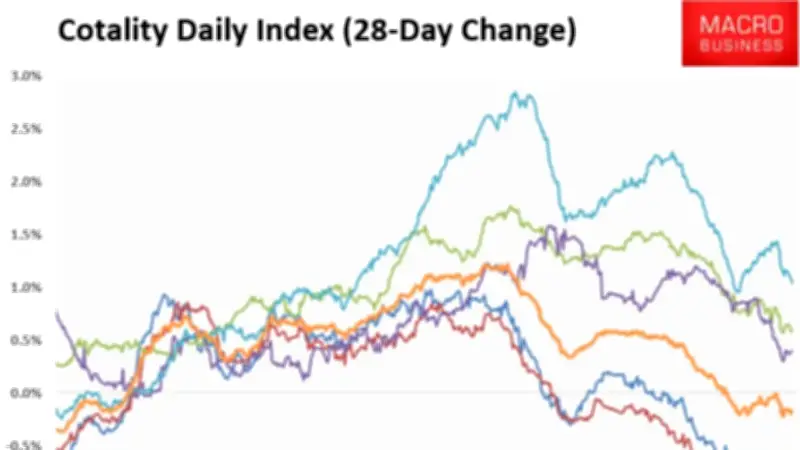
It comes as house prices in Sydney and Melbourne have fallen more than 2 per cent over the past quarter, Cotality's index showed. Macrobusiness Chief Economist Leith van Onselen said auction clearance rates had 'historically been a strong leading indicator of dwelling price growth'. 'Therefore, the falling auction clearance rates suggest that values will continue to fall,' Mr van Onselen said.
Real estate agents are hitting the phones, with some facing redundancies or career pivots, as listings pile up and homes stay on the market for longer. Homes in every major city have recorded an increase in median days on the market compared to last month, according to independent price tracker Spachus Aus. Sydney and Melbourne properties reached 30 days, up 6 days and 4 days respectively. And SQM Research figures showed both cities have seen a 12 per cent rise in total property listings compared with last year.
Negative Equity Risk for First-Home Buyers
Some Aussies who took advantage of the government's 5 per cent deposit scheme to buy their first home in Sydney or Melbourne now face the prospect of negative equity if prices keep falling.
Why Is the Property Market in Decline?
Housing measures in last month's federal budget included restricting negative gearing and replacing the capital gains tax (CGT) discount with an indexation model for established residential property — two changes aimed at warding off investors. But the housing market was already showing signs of cooling before the budget, thanks to consecutive 25-basis-point hikes by the RBA in February, March, and May, bringing the official cash rate to 4.35 per cent.
Commonwealth Bank and ANZ are predicting that the cash rate has peaked and will be held for an extended period. Other banks have a more hawkish view. NAB is tipping a 25-basis-point hike in August, bringing the cash rate to 4.60 per cent. Westpac is forecasting two additional 25-basis-point hikes in August and September, which would bring the cash rate to 4.85 per cent.
AMP Chief Economist Shane Oliver is also predicting two 25-basis-point hikes, having recently revised his forecast up. 'We had been expecting one more in August, but we think there is a risk of another one probably in November,' Mr Oliver told news.com.au. Mr Oliver said the country was facing inflation headwinds due to higher fuel prices and the Fair Work Commission's decision to boost the minimum wage.

Headline inflation fell to 4.2 per cent in April, but Mr Oliver said that was partly due to the fuel excise cut, which was due to end at the end of this month. If the Strait of Hormuz remained closed, the reinstatement of fuel taxes implied a 0.6 per cent boost to headline inflation, he said. 'The other complication is last week we've seen that widely expected wage rise from the Fair Work Commission. And that adds to cost and price pressures in the economy — that's what caused us to pencil in another hike for November.'