Deloitte has warned that 2026 will be the 'year of AI disruption' for Australian workers, with new jobs forecast to nearly halve within two years. The major consultancy firm released a list of 82 occupations facing the highest risk from artificial intelligence, including managers, librarians, graphic designers, and medical imaging professionals.
In its report Employment Forecasts: The Year of AI, Deloitte identified roles with high amounts of tasks that could be replicated by AI, potentially leading to reduced demand for human workers. The firm also predicted that Australia's jobs growth rate would almost halve between 2025 and 2027 due to broader economic conditions.
Current Impact and Future Projections
David Rumbens, Deloitte Access Economics partner, told news.com.au that while some organisations have announced job losses attributed to AI, the overall picture is not yet one of mass losses. 'We've seen some organisations announce job losses and attribute that, at least in part, to AI,' he said. 'But if you look more broadly at the occupations most likely to be affected, you wouldn't say that there's been employment losses overall.'

Deloitte's forecasts indicate that the affected cohort will grow at less than half the rate expected without AI. Over the past five years, these occupations grew by 1.9 per cent per annum. Without AI, that trend was expected to slow to 1.2 per cent, but with rapid AI adoption, growth may drop to just 0.5 per cent per annum.
AI-Driven Job Cuts in Tech
Major Australian tech firms Atlassian and WiseTech have already announced AI-driven job cuts in 2026, eliminating thousands of roles. In the US, Bloomberg reported that tech companies revealed over 38,000 job cuts in May alone, bringing the year's total to 125,623.
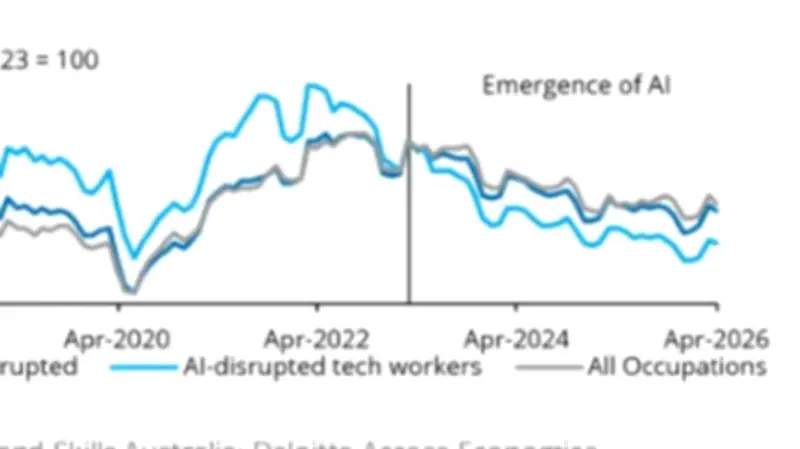
Deloitte noted that vacancies in AI-disrupted tech jobs fell by 17.8 per cent on average for the three years to June 2026, well above the 9.9 per cent decline for the wider labour market. This suggests the trend is 'not just a result of cyclical labour market behaviour' and is 'likely disproportionately falling on entry-level workers.'
Expert Opinions on AI's Impact
Clinton Free, a professor at the University of Sydney Business School, described Deloitte's report as 'fairly optimistic' and consistent with other projections. However, he cautioned that it is too early to predict the full impact of fast-evolving AI. 'This reminds me of the start of Covid when everyone thought the lockdown would last three months, but it took much longer because we didn't really understand it,' he said. 'I think we're in a similar phase now, with a hype cycle where everyone thinks they'll lose their job, then no one does. The truth is AI is changing fast, and there will be uncomfortable disruption.'
Productivity Commission chair Danielle Wood, speaking on The Joe Walker Podcast, said the issue is 'more nuanced' than doomsday predictions of 50 per cent white-collar job losses. She cited a Jobs and Skills Australia report that found only 4 per cent of roles are highly at risk, with 31 per cent likely to be augmented. 'The challenge is how to upskill people to work with AI,' she said.
Broader Economic Context
Deloitte's forecasts show overall new jobs added to the labour market will fall from 304,000 in the year to June 2025 to 192,500 by the end of this financial year, and further to 155,500 in 2026-27. Mr Rumbens attributed this to economic conditions, including productivity and inflation issues. 'We look at vacancies data across AI-affected occupations, and some, particularly in tech, are dropping. That indicates softer employment demand going forward,' he said.
The report also identified 12 'AI-enhanced occupations,' including chief executives, general managers, scientists, primary school teachers, and psychologists. Mr Rumbens noted that technology could be a key lever for solving Australia's productivity issues, but whether AI delivers on its promise 'remains to be seen.'
News.com.au reported last week that AI has been blamed for driving burnout among Australian workers expected to do more with less time.