While everyone is fretting about the cost of living, a reporter made an astonishing discovery when comparing prices to four years ago.
There was one thing on everyone’s mind back in 2022 as we hoped Covid would soon be a thing of the past — the cost of living crisis. And to be fair, it hasn’t really escaped anyone’s mind since then.
The dominant consensus in coverage of the economy and how life has been going for everyday Australians is that the cost of living is still too high, despite inflation cooling after a huge spike four years ago.

It was back then that I undertook an experiment to see how much this spike had hit the pockets of Australians at the supermarkets. I’m no Jamie Oliver, despite the British accent, so I needed something simple to cook and something that required a nice variety of fresh produce, so I decided on a stir fry. I’m not sure where the recipe came from and it wasn’t a terribly exciting dish, but it included everyday fresh staples like chicken thighs and broccoli, as well as a bottle of soy sauce and some wok-ready noodles.
In the 2022 piece, I lamented the “depressing cost” of a basket of ingredients to make the dish. I found that Aldi was cheaper than Coles and Woolies, with the full basket costing $30, compared to the big two supermarkets which cost me about $36 for the same products.
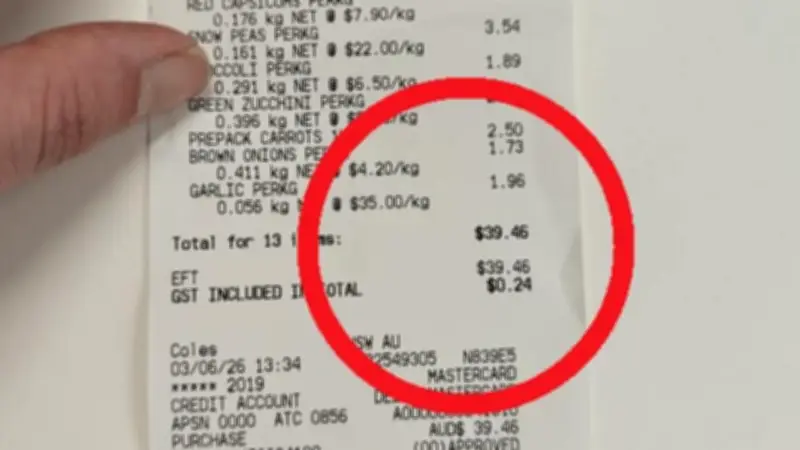
Four years later, with the cost of living still one of the biggest issues facing Australians, I decided to undertake the same experiment. Here’s what I bought: broccoli, carrots, zucchini, mushrooms, snow peas, red capsicum, onions, garlic, soy sauce, noodles and chicken thigh fillets. I bought all of the same ingredients at Coles, Woolies and Aldi this week and I was astonished by what I saw at the till.
It’s worth pointing out that the previous test was done at roughly the same time of year, so seasonal variations in price should not have been a factor. The 2022 test felt like a lifetime ago, so when I was stuffing the items in my basket, I wasn’t really sure what the price difference would be. But I assumed, given all the noise about inflation and the fact that life does not seem a whole lot easier since then, that I would be looking at a much higher overall cost.
However, I noticed some of the items were much cheaper than four years ago. Fresh green vegetables have completely crashed in price compared to their inflated 2022 flood-crisis peaks. Snow peas were one item that dropped by a staggering amount. In 2022, snow peas cost a staggering $35.60/kg at Woolies, $27.76/kg at Aldi and $32/kg at Coles. Those prices have now dropped by a huge amount. Aldi saw a massive 78.6 per cent drop, while prices have crashed 44 per cent at Woolies and 31 per cent at Coles. In 2022, broccoli was nearly $12/kg across the board. By 2026, it settled back down to normal seasonal rates: $4.49/kg at Aldi (down 55 per cent) and $6.50/kg at Coles and Woolies (down roughly 44 per cent).
While the fresh greens plummeted, some grocery staples like poultry and root vegetables had steadily climbed over the four-year span. Garlic prices had jumped up at all three supermarkets. At Coles, it had jumped from $25/kg in 2022 up to $35/kg in 2026 (a 40 per cent increase). Prices at Aldi and Woolies also climbed significantly, with Aldi hitting $29.99/kg and Woolies sitting at $29/kg. Pre-packaged carrots saw a sharp uptick too. A 1kg bag of carrots at Coles rose from a bargain $1.50 in 2022 up to $2.50 in 2026. Chicken thighs at Woolies surged from $11.50/kg in 2022 up to $14.50/kg in 2026, a rise of 26 per cent. Coles also crept up slightly to meet Woolies at the $14.50/kg mark. Soy sauce had also gone up a fair bit. A bottle went from $2.60 to $3 at Coles and $2.50 to $2.80 at Woolies, reflecting the steady rise in imported packaged grocery costs.

So some of the items had increased by a dramatic amount while others had dropped. The moment of truth was at the checkout. To my astonishment, the basket total for all of the items had stayed roughly the same at Woolies and Coles, while the price at Aldi had actually dropped. In 2022, the basket totals at Woolies and Coles cost $36.29 and $36.23 respectively. At Aldi it cost $30. In 2026, the Coles basket was only a few cents more than four years ago, coming in at $36.81. At Woolies, it was over a dollar cheaper, now costing $35.15. Incredibly, at Aldi, the price of the basket had dropped from $30 to $25.81 since 2022.
It should be pointed out that the exact amount I bought of each vegetable was obviously not the same as the previous test, and that several imported packaged goods you would need to actually make the stir fry, like oil and spices, were not on the list. Retail expert and Queensland University of Technology professor Gary Mortimer said packaged products like coffee, sugar, wheat, grain, oil and cacao have spiked dramatically at various points over the past four years. “When it comes to food and groceries, there’s lots of input costs that can inflate pretty quickly the retail price,” he told news.com.au. “Recently we’ve seen the price of cocoa increase and also the price of coffee grains. Cacao was a big one early this year. It was originally about $US2000 a tonne and then it really peaked at almost $US12,000 a tonne. So it went up 600 per cent.” That means that if spices and oils were factored into my experiment, there could have been a spike in the total basket price over the four years.
The cost of living debate is not only about supermarket prices either, as interest rates have jumped dramatically since 2022. If you were buying the stir fry ingredients in 2022, you likely would have had more spare cash because the cash rate back then was just 1.35 per cent. Today, the cash rate is 4.35 per cent, meaning households are far more pressed for disposable income than they were four years ago. It also would have felt more painful in 2022 because inflation had suddenly shot up over the previous 12 months due to Covid and supply chain issues. So although the total basket price is the same or cheaper, it would likely have felt more expensive in 2022.
I took the ingredients home and made a whopping stir fry for the family. My precocious three-year-old daughter said “thank you for the lovely dinner” despite eating two bites and standing up, while my cold-ridden six-year-old son said “Yuck, I hate this dinner” before shoving it aside. I guess you can’t please everyone.
The stable prices of my basket of goods was a surprise to me due to the oil crisis, but Prof Mortimer warns we may see the true impact of increased fuel prices later this year. He said we could see big spikes in the coming six to 12 months, as trucking companies had absorbed a lot of the increased costs so far. “The Fair Work Commission put forward a mandate for retailers, wholesalers and manufacturers to review their third-party logistics contracts every two weeks rather than when the contracts end,” he said. “So, I think trucking companies have absorbed that price to some extent, and then manufacturers and retailers have absorbed that cost. But I think it’s now getting to a point where you will start to see those costs filter into retail prices. And then, of course, we’ve got increases in insurance, electricity, and utility costs. All of those costs continue to inflate, and as they inflate, that puts more pressure on operational costs, which obviously puts more pressure on retail prices.”
Treasurer Jim Chalmers said helping with the cost of living is one of the government’s top priorities. “It is why we’ve backed higher wages for workers, delivered tax cuts that the Liberals voted against, and provided plenty of cost of living relief like cheaper medicines, cheaper childcare, more Medicare bulk billing, slashing student debt, help with energy bills and help with rents,” he said in a statement to news.com.au. “We recognise that Australians are still under pressure and that’s why fighting inflation and helping with the cost of living were both front and centre of the budget. We’re delivering more tax cuts for workers, including a new round of tax cuts starting in July, help with fuel costs, help for more Australians to get into homes, more funding for public hospitals, cheaper medicines and support for higher wages.”
A Coles spokeswoman said: “We know cost of living remains a key concern for many Australians, which is why helping customers get more from their grocery budget remains a key focus for us. We continue to invest in providing value through weekly specials, Flybuys offers and our Coles Own Brand range to help customers save on the products they buy most often. We’re committed to providing quality food at affordable prices and helping Australians make their grocery budget go further every time they shop with us.”
A Woolworths spokeswoman said: “We are always looking for ways to deliver value to customers, as Australian households face growing inflationary pressure on their budgets. There are currently more than 4,000 products on Lower Shelf Price and Everyday Low Price programs, plus our weekly specials, which cover a wide range of branded and fresh products. From 1 May, we have also frozen the shelf price of 300 popular products for three months to provide customers with more certainty at the checkout as part of our Price Freeze commitment.” Aldi has been contacted for comment.