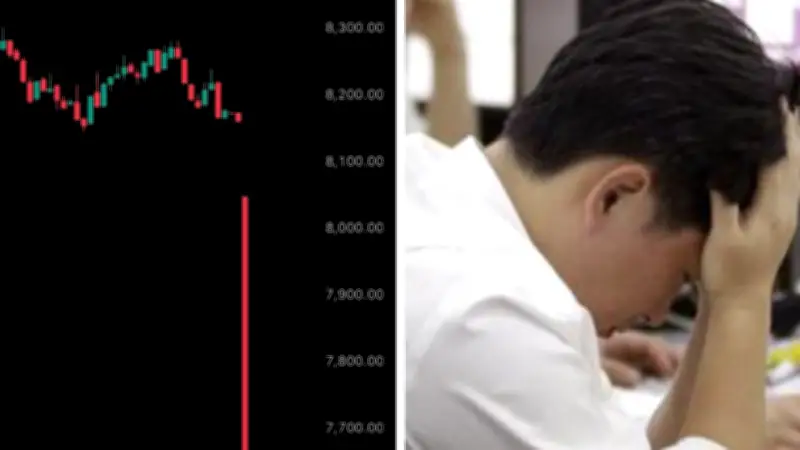
Australia has been spared the immediate pain of a stock market bloodbath thanks to the public holiday, but ominous signs point to a grim opening when trading resumes tomorrow. Pandemonium struck Wall Street on Friday night, wiping out more than $2 trillion in a massive sell-off triggered by stronger-than-expected jobs data. The turmoil has rippled across global markets, with South Korea's stock exchange forced to halt all trading for 20 minutes after the Kospi index of its largest companies crashed more than 8 percent. The benchmark later narrowed its drop as major players like Samsung and SK Hynix Inc. rebounded slightly. However, the ASX is bracing for a severe hit on Tuesday following the brutal Wall Street sell-off over the weekend.
Why Are Stock Markets Crashing?
The trigger point appeared to be the release of a US jobs report on Friday, which showed employment running higher than expected, leading to a sharp downturn on Wall Street. The S&P 500 index of top companies dropped a massive 2.64 percent in trading, while the NASDAQ plummeted 4.18 percent. In Korea, the stock market plunged by 8 percent, prompting the temporary halt. Investors fear that a strong labour market will push the Federal Reserve to switch its focus to combating inflation through rate hikes later this year. This would come at a bad time for the AI industry, which has been the main driver of US stock market growth in recent years and is seeking vast amounts of cash to fund expansion. Major players like SpaceX, Anthropic, and OpenAI are attempting to raise trillions of dollars to finance their ambitious growth plans, pushing up earnings and share prices of computer chipmakers and other technology stocks. All three companies are looking to list on Wall Street to raise money from everyday investors, including those in Australia. SpaceX's IPO is scheduled for Friday, US time.
One concern is that if the US is forced to increase interest rates, it will become even harder for these companies to secure the funding they need to sustain growth. Another fear is that the sector is a bubble that could burst if major players fail to generate serious cash to justify their massive spending. President Donald Trump, however, expressed bafflement at the market reaction, insisting on social media that 'stocks should go up, not down,' adding, 'Growth does not mean inflation!'

Global Stock Markets Hammered, War Fears
It is not just fears of an AI collapse that have the world worried, as Asian markets tumbled on Monday. News that Iran and Israel had struck each other sparked concerns about an escalation of the Middle East crisis, adding to the gloomy mood on trading floors and sending oil prices surging more than three percent. The technology sector bore the brunt of losses on Monday as investors cashed out following a breathtaking surge in recent months, powered by a race into all things linked to artificial intelligence. The selling came after a closely watched report on Friday showed more than double the amount of US jobs than expected were created in May, while figures for the previous two months were revised higher. Analysts said this demonstrated that the world's top economy remained resilient in the face of surging prices but ramped up bets on the Fed raising interest rates. Yields on US Treasury bonds rose as investors anticipated higher rates, while the dollar strengthened against its main rivals.

All three main indexes on Wall Street tumbled on Friday, and that heavy selling extended into Asia, where tech-rich markets felt the most pain. Seoul—which had hit multiple record highs this year—tanked as much as 8.8 percent at one point, with chipmaker Samsung shedding nine percent and rival SK hynix losing six percent. Taipei sank more than five percent, Tokyo more than four percent, and there were hefty losses in Hong Kong, Shanghai, and Singapore. Bitcoin hovered around $63,000 after sinking below $60,000 on Friday to its lowest level since October 2024, just before Mr. Trump's election, which had propelled it to a record high. 'Stronger-than-expected labour market data reignited concerns that the Federal Reserve may be preparing to embark on a new tightening cycle (increasing rates),' said SPI Asset Management's Stephen Innes. He added that 'fading hopes for progress in Middle East peace negotiations kept energy markets on edge, and a handful of disappointing guidance updates from major technology companies interrupted what had become an increasingly one-way artificial intelligence trade.'
Investors were already concerned about extended valuations in the AI realm, which has been the main catalyst for a global market surge over the past two years, eclipsing worries about the Middle East crisis. US chipmaker Broadcom's below-forecast revenue outlook for the third quarter added to those concerns. Fears about a re-escalation of the Iran war pushed crude prices sharply higher after Israel said on Monday it had struck targets in western and central Iran, as Iranian state TV reported explosions in the cities of Tehran, Tabriz, and Isfahan. The attacks came a day after Israel said its military intercepted incoming Iranian missiles, the first such barrage since an April ceasefire took hold. Tehran called the attack a 'warning' after strikes on Beirut's southern suburbs.