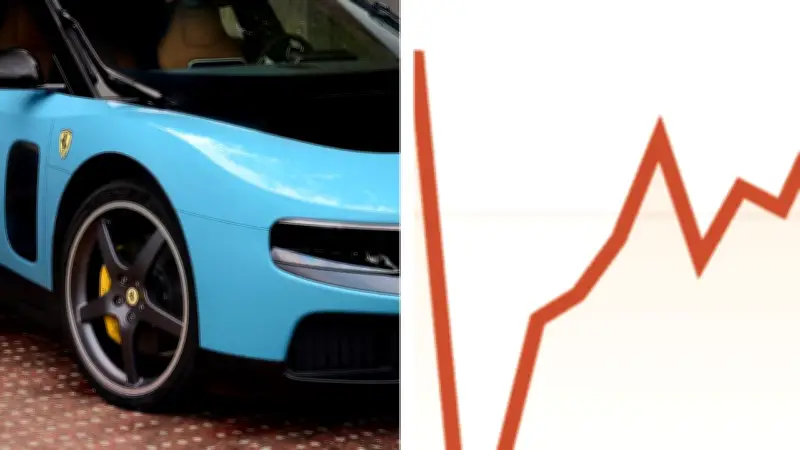
Savvy investors have cashed in on the 'outrage' surrounding the launch of Ferrari's first electric vehicle, the Luce, making thousands as the brand's share price bounced back from a sudden drop.
Ferrari shares rebounded spectacularly after the Luce reveal. Prior to the unveiling, the company's stock closed at €301.55 on the Friday before it debuted, rose to €310 imminently before it broke cover, then fell to €284.05 as the world was shocked by a pale blue four-door missing the brand's usual edge. Today the price sits at €305.70.
Investors who bought shares shortly after the reveal are cheering. UK entrepreneur Lawrence Whittaker posted a screenshot to X.com showing he had made €595.77 ($975) in a few days following a £10,575 ($20,000) investment. 'Twitter outrage is irrelevant to real life,' they say.

A New Direction for Ferrari
If you can cut through the noise of outraged petrolheads on Instagram, there is a reason why the automotive world went quiet when Ferrari unveiled the Luce. Industry insiders were curious to see how a company that led the way for so many elements – racing, turbochargers, hybrids, driver assistance, materials and more – might approach electric vehicles and light a new path for all brands.
The answer is that it took a clean-sheet approach to deliver a practical yet luxurious family car that shares more with Tesla than two-door supercars. It certainly is a Ferrari unlike any other.
Many observers were not afraid to share their opinion, including former chairman Luca di Montezemolo. Having declared 'you will never see a Ferrari electric, because I don’t believe in electric cars' years ago, the Italian took a look at the Luce and said he was 'truly sorry' to see an EV wearing the marque’s iconic badge, suggesting they 'remove the Prancing Horse'.
But the Ferrari Luce is not for retired executives born in the 1940s. It’s for markets like China, where there are enormous financial penalties for choosing EVs, and cities like Paris, which have telegraphed plans for an outright ban on any combustion-powered vehicle. It’s for Ferrari owners who might have an EV as their daily drive and a supercar for weekends.
Built Like No Other Ferrari
The Luce has more in common with other Ferraris than you might think. Like any combustion-powered Ferrari, the car is crafted in Maranello, its hardware honed alongside traditional motors. I toured the factory and saw motor housings for Luce positioned side-by-side with V12 cylinder heads. I saw prototypes running around the same Fiorano test track built around Enzo Ferrari’s house to test new models. And the state-of-the-art factory where the Luce will roll down the same production lines as its F1-inspired 849 Testarossa.
Ferrari chief executive Benedetto Vigna recognises some customers will be so offended by the idea of a four-door Ferrari EV that they will never consider the car. But he won’t apologise for it. Initial production of the car has sold out, and the company’s share price has bounced back to where it was shortly before the unveiling.
The Luce was never going to be a wedge-shaped supercar with a massive petrol engine replaced by electric motors. 'When you develop a new technology, you need to understand the deep profound advantage of the technology and the design must be coherent,' Vigna said. 'If you keep seeing the new technology with the old eyes, then you’re wasting your time.' Which is another way of saying that an electric Ferrari had to capitalise on the aerodynamic and packaging benefits offered by EVs.
Electric Addition, Not Replacement
Vigna is adamant the Luce is not a replacement for existing models. The brand’s very first car had a naturally aspirated V12 engine, and you can still find that in the latest Ferrari 12Cilindri. It has added turbocharged and hybrid models over the years, and even an SUV in the four-door Purosangue – all bolstering the range, rather than replacing the brand’s central elements. 'A lot of companies talked about electric transition, we talk about electric addition,' Vigna said. 'It’s the client selecting the car they believe is the right one for different moments.'

Many car makers are run by sales or marketing execs. But Vigna is a physicist whose resume includes the tiny widget used by iPhones to understand their orientation. No wonder the company turned to former Apple designers Jony Ive and Marc Newson to style the first electric Ferrari.
Newson, an Aussie who has worked with Qantas and RM Williams, describes the Luce assignment variously as a 'loaded project', 'serious thing' and a 'big one'. It certainly got the world’s attention. If we described the response as glowing, it would be from the embers of a nuclear strike of negativity surrounding the car. But social media struggles to convey the bold aero at work in wings floating above lights at the front and rear.
Interior Triumph and Future Directions
And there can be no doubt the interior is a triumph. In a world where cars are turning to simple (and cheap) touchscreens or plain electronic displays for the dashboard and centre console, the Luce employs exquisite alternatives that set a new standard for electronic displays. They also ditched awful touch-sensitive plastic elements that feature in other Ferraris, replacing them with lovingly finished knobs, buttons and dials for key controls. It’s one of the ways the Luce could light the road ahead for the rest of the car industry, which may follow suit by making cabins more tactile.
Then there are the four-wheel electric motors that promise to deliver a kind of agility we’ve not experienced in any EV – or any four-door car at all, really. And the holistic approach to numbers. The Luce didn’t chase a headline-grabbing lap time, power figure or enormous electric range – even if it does claim 772kW of wallop, 530km of range and the ability to hit 100km/h in 2.5 seconds. Bigger digits would have required compromises that Vigna and his team were not willing to make.
Hopefully other brands follow their lead. 'Sometimes you keep hearing ‘this car goes from 0 to 100 in 1.6 or 1.7 seconds’, and I say ‘so what?’,' Benedetto said. 'When I hear these things, I am always laughing, you need to find the right balance. It’s nice to have some salt on the food, but if it’s too much, we don’t like it. You have to find the right equilibrium.' And Ferrari may have done just that.